
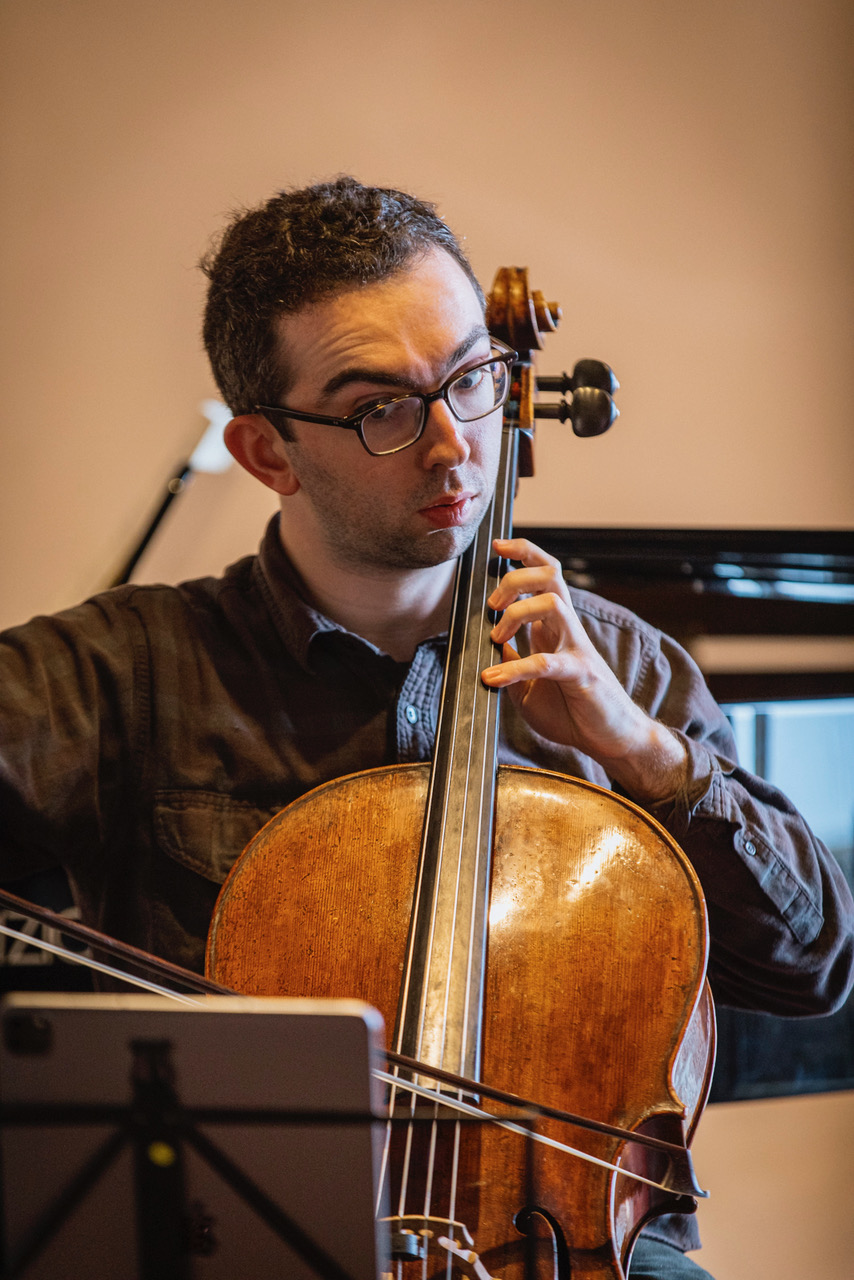
Macintyre Taback, cellist of the Abeo Quartet
By Maria Grant
The Abeo Quartet is returning to The Ebenezer on March 1. Their first appearance in Easton, a triumph, was at the 10th Biennial Chesapeake Chamber Music Competition in 2022 where they took home the Silver Prize.
The Abeo Quartet is comprised of cellist Macintyre Taback, violinists Njioma Grevious and Rebecca Benjamin, and violist James Kang. Violist Milena Pajaro-van de Stadt, who has performed recitals and chamber music concerts throughout the U.S., Latin America, Europe, and Asia, will join the Quartet at this performance.
I had the opportunity to interview cellist Macintyre Taback about the history of the Abeo Quartet and their rationale for selecting this particular program to perform in Easton.
I’m curious about the name of your quartet: Abeo. I understand that it is based on a Yoruba name meaning “the bringer of happiness, joy, or delight.” Tell us how the Quartet decided to select this name.
When the original members founded the quartet at Juilliard in 2018, they wanted a name that spoke to the feelings of joy and happiness. One of the violinists, Njioma, is from Nigeria, and like many other Nigerian names, her name has some musicality to it. So, the quartet decided to search for other Nigerian words or names that represent joy and happiness. During their brainstorming, they started with baby names. Everyone loved Abeo as it means bringing joy in a Nigerian dialect. And that’s how we became the Abeo Quartet.
How did you come together as a quartet?
The group formed at Juilliard in 2018, out of the Freshman String Quartet Seminar. They went on to participate in the Juilliard Honors Chamber Music program, and at that point especially felt a real chemistry as a group. Since then, there have been a few member changes (Rebecca Benjamin in 2021 and me in 2024), but the spirit of the group has luckily remained the same!
What is the program for the March 1 concert in Easton?
Dmitri Shostakovich: String Quartet No. 11, Op. 122; Adolphus Hailstork: String Quartet No. 2, Variations on ‘Swing Low, Sweet Chariot’; and, Johannes Brahms: String Quintet No. 2 in G major, Op. 111 (with violist Milena Pajaro-van de Stadt)
Why did you select these pieces? What is special about each one? And why do they work together as a cohesive program?
The program we have devised for our March 1 concert in Easton consists of some of our absolute favorite pieces to play, as well as one that has been on our bucket list for years.
This particular Shostakovich quartet is one of the least often played of his 15 quartets, which is completely baffling to us. It explores an extraordinary range of dark emotions and feelings in just under 17 minutes, each movement seeming to represent a particular stage of grief. One notable aspect of this piece is that the work is somewhat ‘cyclical’, meaning that musical motives from early in the work tend to reappear later on, albeit sometimes transformed or disguised. Additionally, each movement is played ‘attacca’, or without pause into the next movement. We feel lucky to introduce this piece to the Chesapeake audience.
The Hailstork Second Quartet is a recent addition to our repertoire, and a fantastic work by an American composer who has to this date not received enough attention. Hailstork’s modernist compositional language at first obscures the familiar ‘Swing Low, Sweet Chariot’ theme, finally allowing it to speak clearly at the end of the piece in a way that is utterly beautiful. Some variations are lively and playful, others introspective. We are excited to have the chance to play this work more often in coming seasons.
Brahms’ Second String Quintet will likely be familiar to many in the Chesapeake audience, as it is one of the most beloved works in the chamber music repertoire–and for good reason! Brahms wrote in an 1890 letter to his publisher, Fritz Simrock, that this would be his final piece of chamber music, and it is full of ecstatic joy, strong Hungarian influence (as in his famous Hungarian dances), and some of his most beautiful melodies. The addition of an extra violist gives the sound of this piece unbelievable depth and richness, and at times can make the group sound more like a full string orchestra than its five-member orchestration would suggest. All in all, if this program starts from a place of grief, it certainly ends with a life-affirming spirit.
Is there any preparation the audience should do before attending the concert? Are there specific things for which they should listen?
The music in this concert will speak for itself–no homework necessary–but if you are interested, please give a listen to some of Adolphus Hailstork’s other music! His musical voice is unique and striking, and as with many other contemporary composers, it may take a few listens to familiarize oneself with his expressive language.
Violist Milena Pajaro-van de Stadt will accompany your quartet in performing Brahm’s second viola quintet. Tell us about this collaboration.
Milena is one of the most incredible violists and musicians in the world today, and we feel extremely lucky to have the chance to collaborate with her in the Brahms G major Viola Quintet. Various members of our group have learned from her in the past, and it will no doubt be special to get the chance to perform with her.
According to my research, all four of you in the Abeo Quartet started playing a musical instrument at a very early age. How significant is that fact in making you the musicians you are today?
To play a string instrument at a high level, it definitely helps to start as a child, and to become serious about the craft of making music early on. The four of us started playing at ages ranging from 4 to 12 years old. Also, we were all especially lucky to have had early chamber music experience, which is as important at a certain stage of development as is really good instrumental teaching and practice. We have fond memories of our first ever string quartets, or piano trios, and had great and inspiring chamber music coaches who let us in on the magic of the genre.
You studied at Juilliard and then were mentored by the Calidore String Quartet at the University of Delaware. What brought you to each of these educational institutions, and how did they make a lasting impact on your musical journey?
The quartet formed at Juilliard as a part of the school’s Freshman String Quartet Seminar, and our wonderful coaches and peers at Juilliard began to show us the intensity and variety of expression that a string quartet can produce. The influence of the Juilliard String Quartet, among others, on our group during our most formative years has made an indelible impact on the way that we make music.
The chance to work with the Calidore Quartet during the first year of their Quartet Residency program at the University of Delaware was a huge gift to us and came at a time when we were already aiming for a professional career as a string quartet. We had achieved some success in competitions and were really looking to bring our music-making and quartet technique to the next level. The Calidore is an amazing group on every metric, but what was particularly valuable to us is that they were in our shoes not so long ago– while the four members are deeply experienced and inspiring coaches, they could also serve as our mentors as we entered the professional world since they had gone through the same process quite recently. We recently had the chance to play the Mendelssohn Octet with them in Seattle, and it was a beautiful full-circle moment, since I simultaneously had the chance to meet them as Abeo’s new cellist.
Pairing classical and contemporary musical selections is always exciting, especially for students and younger audiences who love the variety. What advice do you have for our audiences as they listen to newer works, or to composers with whom they are less familiar?
We seek to program music which we find expressive and engaging, no matter the style. However, some 20th and 21st century pieces are written in a musical language which isn’t immediately as accessible to many audience members as, say, that of Brahms or Mozart. We will speak before the concert about what we love in each piece and will provide a clear angle through which to experience these less familiar pieces for the first time.
It’s especially important to remember that there is no right or wrong, and that whatever you can grasp onto or enjoy in a piece of music upon first hearing it is exactly what you should be hearing! We really think you will enjoy the Hailstork and Shostakovich, even if those are composers you aren’t already accustomed to.
The last time the Abeo Quartet was in Easton you won the Silver Prize in Chesapeake Music’s 2022 Competition. What are your thoughts about coming back to this city and the Ebenezer Theater?
The Quartet cannot wait to come back to Easton. While the Chesapeake competition wasn’t that long ago, it’s amazing how far we have come and what has changed since the 2022 competition. Aside from the competition being a pivotal moment in our early career as a quartet, Abeo has fond memories of the warmth of the audience, as well as the beautiful acoustics of The Ebenezer Theater. We are excited to share this program of well- and lesser-known works with your wonderful audience!
Chesapeake Music offers a limited number of free tickets to students, educators, and Talbot County First Responders, as well as a “buy-one-get-one” option for first-time patrons of Chesapeake Music. Based in Easton, Maryland, Chesapeake Music is a 501(c)(3) nonprofit organization that brings renowned musicians to delight, engage, and surprise today’s audiences, and educate, inspire, and develop tomorrow’s. For tickets and more information, visit ChesapeakeMusic.org.
