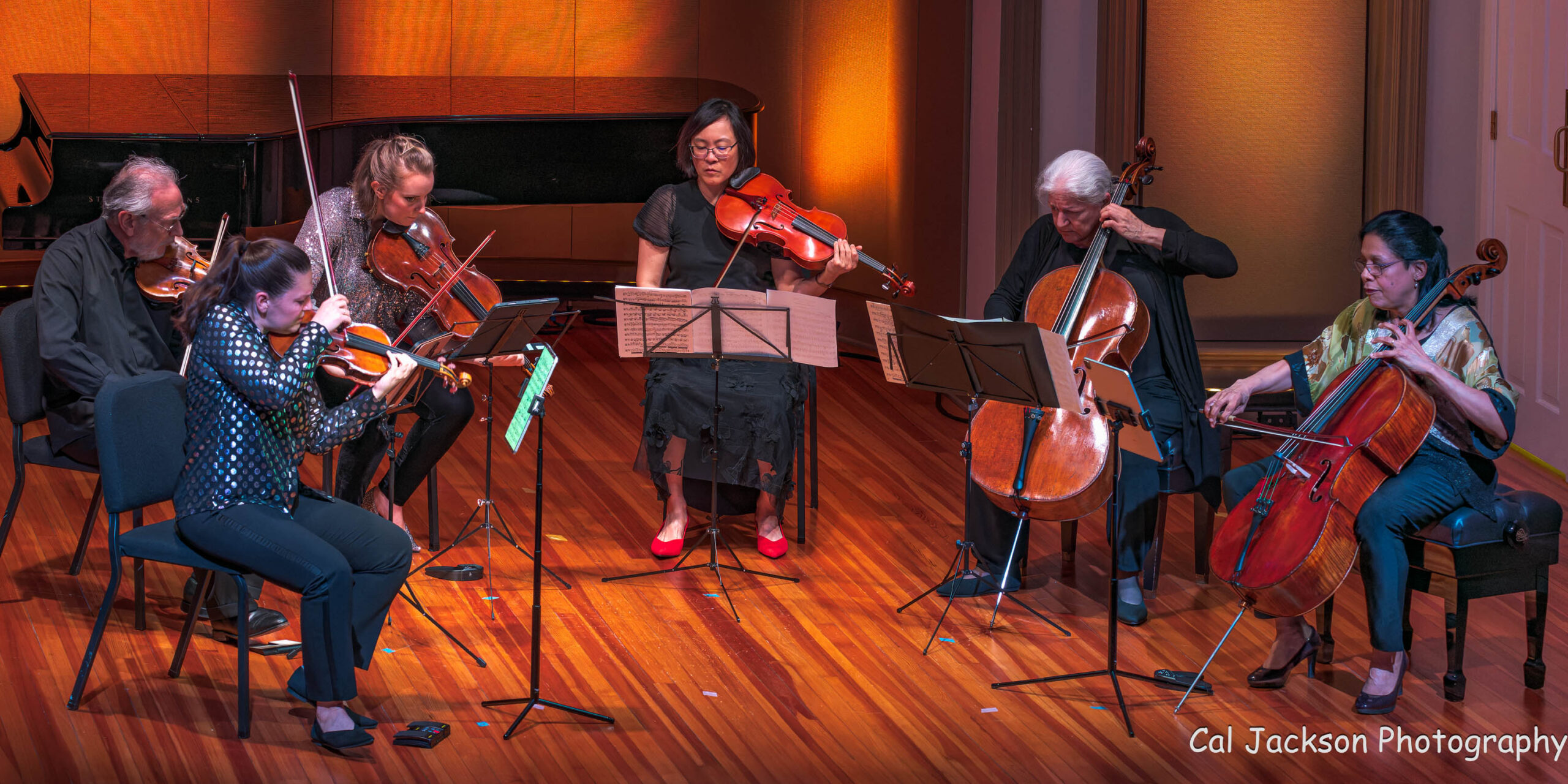
Artistic Directors Marcy Rosen and Catherine Cho performing alongside the Juilliard String Quartet at the 40th anniversary Chesapeake Chamber Music Festival in 2025 (photo credit: Cal Jackson)
By James Carder
If a symphony is a towering cathedral, then chamber music is an elegant, intimate room that fosters the art of a musical conversation among friends. This year’s Chesapeake Chamber Music Festival and its artistic directors, Marcy Rosen and Catherine Cho, have programmed several masterpieces that amply demonstrate this fact. Stretching from the refined grace of Mozart to the sweeping passion of Tchaikovsky, these works are more than just chamber music staples. They are masterpieces, residing at the pinnacle of the chamber music genre.
The Festival’s “Opening Extravaganza!” on June 12th features Antonin Dvořák’s second piano quintet. Often cited as the “perfect piano quintet,” Dvořák treats the piano and strings like a seasoned debating team, where the musicians have the chance to voice almost every emotion from haunting melancholy to pure, ecstatic joy. The opening work at the June 13th concert is Wolfgang Amadeus Mozart’s Violin Sonata in E Minor. Among Mozart’s dozens of sonatas, this one is an outlier. It is his only violin sonata in a minor key and was written around the time of the death of his beloved mother. It is a stark, intimate, even tragic work. As one critic has written, this violin sonata “proves that greatness doesn’t require a hundred-piece orchestra; two instruments are enough to break a heart.”
A well-known and beloved masterpiece is programmed for the June 18th concert: Franz Schubert’s famous Piano Quintet in A Major, “The Trout.” This sunny, joyful work includes a set of variations on Schubert’s own song, Die Forelle (The Trout). The unusual addition of a double bass relieves the cello from having to be the lowest voice in the ensemble, freeing it to exploit its higher register and create a shimmering sound that perfectly mirrors the bubbling waters in the song.
Two masterpieces close the Festival on June 20th: Johannes Brahms’s “Horn Trio” (Trio in E-flat Major for Horn, Violin and Piano) and Pyotr Ilyich Tchaikovsky’s “Souvenir de Florence” (String Sextet in D Minor). Brahms’s “Horn Trio” is a deeply personal, albeit noble work, written following the death of his mother. In his “Souvenir de Florence,” composed after a visit to Italy, Tchaikovsky pushes the six strings to their limits, creating a wall of sound that rivals a symphony. The piece fuses Italian melodic sweetness with the muscular, rhythmic drive of Russian music and is a powerhouse of energy (especially the Finale).
The Festival programming includes other important works of the standard chamber music canon. Brahms’s String Sextet No. 1 (June 14th) and his String Quartet No. 2 (June 18th) are revered for their classical structural perfection. Brahms was a perfectionist who famously destroyed dozens of compositions before he felt he had reached the “greatness” of Beethoven. The Festival’s three works by Brahms are therefore the survival of the fittest – music that was labored over until every note served a purpose. Schubert’s String Trio in B-flat Major (June 19th) is an unfinished gem of brevity that is light and elegant. In contrast, Mozart’s Horn Quintet in E-flat Major (June 18th) is almost a mini horn concerto, unusually employing two violas that create a mellow, dark backdrop for the horn. And cellist Marcy Rosen will partner with pianist Robert McDonald (June 14th) in a performance of Beethoven’s Cello Sonata No. 5 in D Major, often described as a defiant masterpiece that pushes the cello to its expressive limits, most notably through its complex, technically difficult concluding fugue.
These classical masterpieces are not great simply because they have become “standards” in the repertoire. They are great because the musicians engage in powerful and emotionally vulnerable “conversations” with each other. Come to the Chesapeake Chamber Music Festival and experience this for yourself as it unfolds in the intimacy of the beautiful Ebenezer Theater In Easton, Maryland. Detailed information on the Festival concerts, including programs, dates, times and ticket availability, can be found at ChesapeakeMusic.org.
Chesapeake Chamber Music Festival
June 12–20, 2026
June 12 at 7:30 p.m.
Festival Opening Extravaganza!
June 13 at 7:30 p.m.
Music of Four Nations
June 14 at 4 p.m.
Heritage and Home
June 18 at 7:30 p.m.
Bridging the Eras
June 19 at 7:30 p.m.
Competition Winners and More
June 20 at 7:30 p.m.
Festival Finale
2 Free and Open Rehearsals: June 10 and June 17 at 10:00 a.m.
Chesapeake Music offers a limited number of free tickets to students, educators, and Talbot County First Responders, as well as a “buy-one-get-one” option for first-time patrons of Chesapeake Music and a new “$35 for 35 and under” offer. Based in Easton, Maryland, Chesapeake Music is a 501(c)(3) nonprofit organization that brings renowned musicians to delight, engage, and surprise today’s audiences, and educate, inspire, and develop tomorrow’s. For tickets and more information, visit ChesapeakeMusic.org.